How Does Reducing DSO Improve Cash Flow?
What DSO is, how it ties to accounts receivable, and why cutting it from 50 days to 40 means $100,000 less working capital — or 25% more sales on the same.
Key takeaways
- DSO — days sales outstanding — is your accounts receivable measured in days of sales. Every day of it is money your business has to fund to make the same sales.
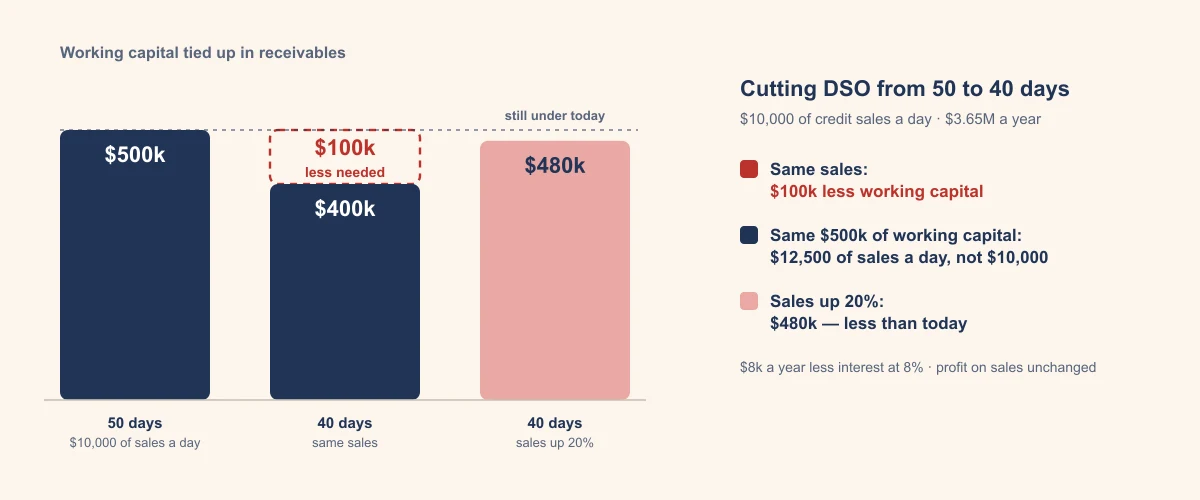
- Reducing DSO lowers that working capital requirement for as long as DSO stays down. At $10,000 of credit sales a day, going from 50 days to 40 means $100,000 less tied up in receivables.
- Or turn it around: the same working capital carries more sales. At 40 days, the $500,000 the Supplier has in receivables would carry $12,500 of sales a day instead of $10,000 — 25% more.
- Profit on the sales doesn’t change. What changes is how much capital you need to earn it.
DSO stands for days sales outstanding: the average number of days between making a sale on credit and getting paid for it. It’s worked out from your accounts receivable — the money customers owe you for sales you’ve already invoiced. DSO = (accounts receivable ÷ credit sales) × 365. Read the other way round, your accounts receivable is simply DSO days’ worth of credit sales. That’s why it matters. Every day of DSO is a day of sales you’ve made, and already paid the costs of, but can’t yet use — and your business has to fund it, from its own cash or from borrowing.
You’ve worked out that customers take 50 days to pay you, and you think you could get it down to 40. The question I usually get next: what does that actually do for my cash flow?
Reducing DSO lowers the working capital your business needs to run. On the same sales, less of your money sits with customers, and the difference comes back to you as cash. With the same working capital, you can make more sales.
That matters because two businesses with the same sales and the same profit can need very different amounts of capital. The one with the higher DSO is the one that runs short when it grows.
This piece is about what a lower DSO does to the working capital your sales need. How to work out your own DSO, and what your receivables hold today, is in how much cash is tied up in accounts receivable — read that first if you don’t know your DSO yet. The tactics for getting paid faster are in how to get paid faster.
How DSO sets the working capital you need
Accounts receivable is roughly a day of credit sales × DSO. That’s the working capital you need to keep in your customers’ hands to make your sales.
Example 1. Let’s say a business sells $1,000,000 a year on credit — about $2,740 a day. Here is what its receivables need at different DSOs:
| DSO | Working capital tied up in receivables |
|---|---|
| 10 days | $27,397 |
| 30 days | $82,192 |
| 60 days | $164,384 |
| 100 days | $273,973 |
How to read it. The sales are the same in every row, and so is the profit. But at 100 days the business needs ten times the working capital it needs at 10 days — about $274,000 against $27,000. That money has to come from somewhere: the owner’s cash, a credit line, or suppliers who are paid late.
Receivables are one part of working capital. Stock and supplier credit are the others — the full picture is the cash conversion cycle. DSO is the part your collections control.
Example 2, used in the rest of this piece. Let’s say the Supplier sells industrial parts to manufacturers on net 30 terms. It invoices $10,000 of credit sales a day — $3,650,000 a year — and its DSO is 50 days. It sets out to bring that down to 40.
Same sales, less working capital
Cut DSO and the working capital your sales need falls by the days cut × a day of credit sales. That money comes back out of receivables as cash.
Example.
| The Supplier, $10,000 of sales a day | DSO | Working capital in receivables |
|---|---|---|
| Today | 50 days | $500,000 |
| Target | 40 days | $400,000 |
| Less working capital needed — 10 days × $10,000 | $100,000 |
How to read it. The Supplier sells the same parts to the same customers, and now runs the business with $100,000 less tied up in receivables. That holds every month that DSO stays at 40 — it isn’t a windfall that disappears. The Supplier can repay $100,000 of its credit line and stay repaid. At 8%, that’s $8,000 less interest every year.
The cash comes in while DSO is falling, not on the day you change anything. If it takes six months to get from 50 days to 40, the $100,000 arrives across those six months.
Same working capital, more sales
Turn it around: the working capital you already have in receivables can carry more sales at a lower DSO.
Example. The Supplier has $500,000 tied up in receivables today. At 50 days, that carries $10,000 of sales a day. At 40 days, the same $500,000 would carry:
$500,000 ÷ 40 days = $12,500 of credit sales a day — 25% more, or $4,562,500 a year instead of $3,650,000.
How to read it. That’s room to grow without putting more money into receivables. The stock and supplier payments that come with more sales still need funding, so check the whole cash conversion cycle before you plan on it. But the receivables part is covered.
Growing on less capital
Every time sales grow, receivables grow with them. At a lower DSO, each extra dollar of sales needs fewer days of working capital.
Example. Let’s say the Supplier’s sales grow 20%, to $12,000 a day:
| After 20% growth | At 50 days | At 40 days |
|---|---|---|
| Working capital in receivables today | $500,000 | $500,000 |
| Working capital needed after growth | $600,000 | $480,000 |
| Change | +$100,000 needed | $20,000 freed |
How to read it. At 50 days, growing 20% needs another $100,000 the Supplier has to find. At 40 days, it can grow 20% and still have $20,000 less in receivables than it has today. That’s why a lower DSO matters most to a business that’s growing — covered in why working capital consumes cash as you grow.
Where it shows in the three statements
The balance sheet swaps receivables for cash. The cash flow statement shows it in operating activities. The income statement doesn’t change.
Example.
| Statement | What changes when DSO falls from 50 to 40 |
|---|---|
| Income statement | Nothing. The same $3,650,000 of sales, and the same profit |
| Balance sheet | Accounts receivable down $100,000; cash up $100,000 |
| Cash flow statement | A $100,000 decrease in accounts receivable, added to operating cash flow |
How to read it. The profit on those sales was recorded when they were invoiced. Collecting sooner changes how much capital it takes to earn that profit, not the profit itself. Under the indirect method, net income is adjusted for the change in receivables during the period (ASC 230-10-45-28), so the fall in receivables lands in operating activities. How the three statements tie together is in how the three financial statements link.
If DSO drifts back, the requirement goes back up
The lower requirement lasts only while DSO stays down. If customers slip back to 50 days, the Supplier needs its $100,000 back in receivables.
That’s why bringing DSO down is a routine, not a project. Invoices go out on delivery, reminders go out before the due date, and late payers get a call the day they’re late. Most of all, someone watches DSO every month. The same habits that bring it down are the ones that keep it down.
Count the cost of getting there
A discount for paying early lowers DSO by giving up profit on every invoice, every year. Compare what it costs with what the freed working capital is worth to you.
Example. Let’s say the Supplier tries to buy its 10 days with a 1% discount for paying early, and every customer takes it. That costs $36,500 a year — about 37% a year on the money it brings in early. The $100,000 of working capital it frees saves $8,000 of interest a year at 8%.
How to read it. That trade costs far more than it’s worth. A discount can still make sense for a single slow customer, or when you have no cheaper way to raise cash. The arithmetic for 2/10 net 30 is in the guide.
The cheaper days usually come from customers paying after the due date. In how much cash is tied up in accounts receivable, that’s the part of DSO above your terms. To find which customers own those days, our free AR payment behavior analysis template measures how late each one pays.
See it move, week by week
Model the change by sales channel before you change any terms, and watch your receivables settle at the lower level.
Our free DSO Cash Impact Calculator compares two cases. One is the credit days each channel takes today. The other is the credit days you’re aiming for, with any early-payment discount. For 13 weeks it shows the cash collected and the receivables balance under each — how much working capital your receivables hold, and how fast it falls.
Example. In the calculator’s sample, credit days are halved on every credit channel in return for a 1% discount. Most of the drop in receivables comes in the first four weeks, when $145,212 of extra cash is collected. After that the gap keeps widening, by under $2,000 a week, because the sample’s sales grow every week and each extra dollar of sales ties up fewer days. By week 13 the business has collected $162,337 more cash, after the discount.
How to read it. That’s this post in miniature: receivables drop to a lower level and stay there, and growth then needs less working capital on top.
Owners usually see DSO as a collections number. I see it as a capital number. When an owner tells me they need a bigger credit line to grow, the first thing I check is how many days of sales are sitting with customers — often the money they want to borrow is already theirs.
Start this week
Work out the working capital your receivables need today, and what they’d need at your target DSO. Then decide what you’ll do with the difference.
Start with the customers paying after their due date — that’s where the cheapest days are.
If you’d like a second pair of eyes on your plan, email me at anant@ease.pro. I hope you have a great day.
Want your DSO brought down — and kept down?
A lower DSO means running and growing the business on less capital. Keeping it there takes a weekly routine — invoices out on time, late payers chased on the day, and the days watched every month. If you’d like experienced finance professionals to set that up from your own ledger and run it with your team, that’s our cash flow work.
Frequently asked questions
What is DSO?
DSO stands for days sales outstanding: the average number of days between making a sale on credit and getting paid for it. It's worked out from accounts receivable — DSO = (accounts receivable ÷ credit sales) × 365 — so it's your receivables balance expressed in days of sales.
How does reducing DSO improve cash flow?
It lowers the working capital your sales need. Accounts receivable is roughly one day of credit sales times your DSO, so fewer days means less of your money sitting with customers. On the same sales, the difference comes back to you as cash. With the same working capital, you can carry more sales.
How much working capital does my DSO tie up?
Annual credit sales ÷ 365 × DSO. On $1 million of sales a year, 10 days of DSO ties up about $27,400; 100 days ties up about $274,000 — ten times as much, for the same sales and the same profit.
Is reducing DSO a one-time benefit?
No. The cash comes in while DSO is falling, but the lower working capital requirement lasts for as long as DSO stays down. Every year after, you're running the business with less money tied up in receivables, paying less interest on it, and needing less new capital each time sales grow.
Does reducing DSO increase profit?
Not directly. The sales and their profit were recorded when you invoiced them; collecting sooner changes when the cash arrives, not how much you earned. Profit improves through what follows — less interest on the working capital you no longer need to borrow. An early-payment discount reduces profit.
Where does a lower DSO show on the cash flow statement?
In operating activities. Under the indirect method, net income is adjusted for the change in receivables during the period (ASC 230-10-45-28), so a $100,000 fall in receivables appears as a $100,000 decrease in accounts receivable, adding to operating cash flow. The income statement doesn't change.