Should You Forecast Customer Receipts Using Invoice Due Dates or Actual Payment Behavior?
When customer payment behavior should override the due date in a weekly cash flow forecast — the businesses that need it and the flags that say it's time.
Key takeaways
- The due date is what a customer agreed to. Payment history is what they do. For your important customers, forecast the second.
- A Net 30 customer who pays in 44–50 days belongs in the week it actually pays, unless something current says otherwise.
- It matters most where a few customers carry your receipts — and barely at all where customers pay by card or there are hundreds of small ones.
- Six flags tell you it’s time to look. The most common: receipts that keep arriving later than your forecast said.
Your customer is on Net 30. The invoice went out today. So does the cash go into week 5 of your forecast, when the invoice falls due — or into the week the customer actually pays?
For any customer who matters to your cash, forecast how they actually pay. Use the due date only when you have nothing better.
Every cash flow forecast model needs a rule for dating customer receipts. This piece is about why behavior should set that rule, which businesses need it, and the flags that tell you it’s time to look. How to measure a customer’s real payment timing is already covered in how to forecast cash receipts accurately, and our free 13-week AR collection forecast template does it invoice by invoice.
The due date tells you what was agreed, not what will happen
A due date is a promise made when the customer signed up. Payment behavior is a record of what they’ve actually done since. When you’re forecasting cash, the record is the better guide.
Example 1 — Net 30 on paper, 44–50 days in practice. A staffing business — I’ll call it Staffing Firm 1 — invoices a large client $60,000 today on Net 30. The due date puts the cash in week 5. Here’s how that client paid its last six invoices:
| Invoice | Days from invoice to payment | Week this invoice would land |
|---|---|---|
| 1 | 44 | Week 7 |
| 2 | 50 | Week 8 |
| 3 | 46 | Week 7 |
| 4 | 48 | Week 7 |
| 5 | 47 | Week 7 |
| 6 | 49 | Week 8 |
| Median | 47.5 | Week 7 |
Four of the six would have landed in week 7. So the realistic forecast is week 7 — two weeks after the due date — unless something current says otherwise. If week 5 is a payroll week in your weekly cash flow forecast, that’s the difference between a comfortable Friday and a tight one. It’s also why customer payment history belongs on any list of cash flow forecast inputs — and it’s one your accounting system can’t give you.
Read the terms carefully too. “Net 30 EOM” counts from the end of the invoice month, so an invoice raised early in the month can carry close to 60 days — conventions differ, so check your contract. And on “2/10 net 30”, a customer who takes the 2% discount pays about three weeks early.
Which date to use: six levels of evidence
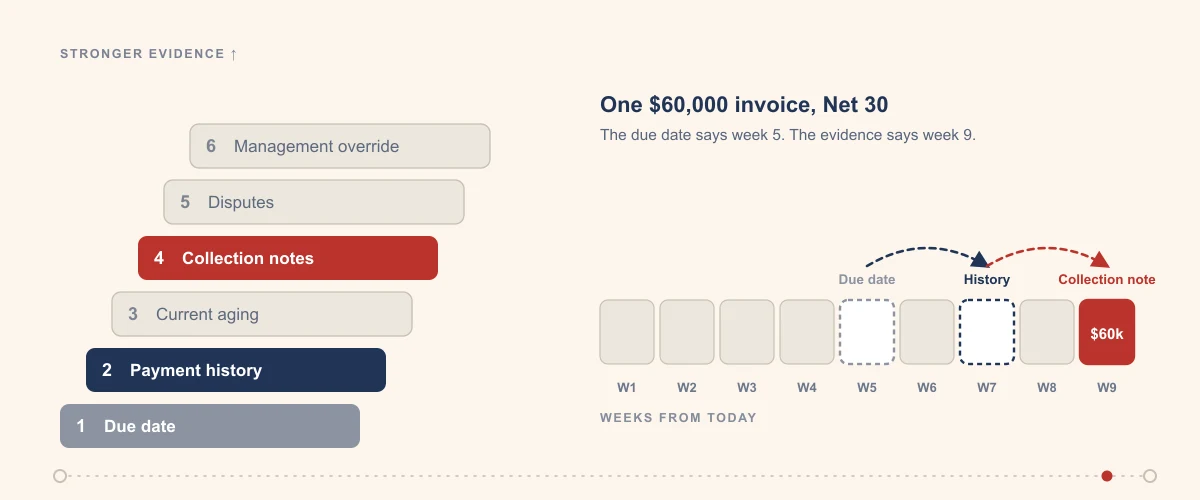
Start with the due date. Once a customer has enough payment history, use that instead. Then let anything you learn about a specific invoice — how old it is, what the customer told you, a dispute, or a management decision — take priority over both. In the table, each level takes priority over the ones above it.
| Level | Evidence | Takes priority when… |
|---|---|---|
| 1 | Contractual due date | you know nothing else — a new customer or a one-off sale |
| 2 | Payment history | you have six or more recent invoices showing a pattern |
| 3 | Current aging | the invoice is already older than the customer usually takes |
| 4 | Collection notes | the customer has told you something about this invoice |
| 5 | Disputes | part or all of the invoice is contested |
| 6 | Management override | someone knows something the data can’t — and writes it down |
So for Staffing Firm 1, history moves the $60,000 from week 5 to week 7. If the client’s accounts payable team then says last month’s timesheets aren’t approved and the invoice will miss its next fortnightly payment run, the collection note wins and the cash moves to week 9.
Disputed amounts come out of the base case and sit on their own line — the same way probable receipts do in committed and probable. And any management override gets a reason and a review date, so it can be checked against what actually arrives.
Which businesses need customer behavior in their cash flow forecast
Customer behavior analysis earns its time where a few customers on credit terms carry the receipts. It matters far less where customers pay at the point of sale.
| You need it most if… | Why |
|---|---|
| A few customers make up most of your receipts | One late payer can move a whole week |
| You sell to large companies | Many pay on fixed weekly or fortnightly payment runs, not on your due date |
| You sell to grocery chains or big retailers | Deductions and short-payments can change the amount, not just the date |
| You bill against approvals — timesheets, milestones, sign-offs | An invoice can’t be paid until it’s approved |
| You offer early-payment discounts | Some customers pay weeks early, and less |
| You can mostly skip it if… | Use instead |
|---|---|
| Customers pay by card or cash at the point of sale | The payout report |
| You have hundreds of small customers | A collection pattern from your own history |
Example 2 — same industry, same terms, opposite answers. Staffing Firm 2 is the same kind of business as Staffing Firm 1, but it offers 2/10 net 30, and its largest client always takes the discount — paying nine days after the invoice.
| $60,000 invoiced today | Due-date forecast | Forecast from payment history |
|---|---|---|
| Staffing Firm 1 (client pays in 44–50 days) | $60,000 in week 5 | $60,000 in week 7 |
| Staffing Firm 2 (client takes the 2% discount) | $60,000 in week 5 | $58,800 in week 2 |
Same industry, same paper terms, opposite mistakes. One due-date forecast is two weeks too early; the other is three weeks too late and $1,200 too high. A rule like “always add two weeks” would fix one and break the other. Only each customer’s own history gets both right.
Example 3 — a different industry, where the amount moves too. A Food Manufacturer sells to a grocery chain on Net 30. The chain has paid its last six invoices in 49–55 days, deducting an agreed promotional allowance of about 5% each time. This month’s $40,000 invoice also carries a $3,000 shortage claim the manufacturer disputes.
| This invoice | Amount |
|---|---|
| Invoice | $40,000 |
| Less agreed promotional deduction (5%) | −$2,000 |
| Less disputed shortage claim | −$3,000 |
| Base-case receipt, week 8 | $35,000 |
The due date says $40,000 in week 5. The customer’s behavior says $35,000 in week 8 — three weeks later and $5,000 smaller, with the disputed $3,000 on its own line until it’s settled.
Six flags that say it’s time to look
You don’t need to analyze every customer every week. These are the signals that a customer’s payment behavior has started to matter — or has changed.
- Customers pay later than their terms, consistently. If your DSO sits well above your terms, the due dates in your cash flow forecast are overstating your near-term cash. How to get paid faster →
- One customer carries a tight week. If a payroll week depends on one customer’s payment, its behavior is worth more than its terms.
- An invoice is older than the customer usually takes. History can’t place it any more. Find out why before you forecast it again — and don’t keep moving it to next week.
- Deductions or short-payments start appearing. The cash is arriving, but less of it. Forecast the amount you actually receive.
- Something changes at the customer. A new payment run, a new finance team, an acquisition, a request for longer terms. Past behavior may no longer apply.
- Your receipts forecast keeps missing in the same direction. Compare forecast with actual by customer, as in how you know your receipts forecast is accurate. If the same customer is late every week, update its history rather than moving the week.
The first flag I look for is the second one. When a payroll week rests on a single customer’s payment, I want that customer’s last six payments in front of me before anyone tells me the week is fine.
Start this week
Pick your top ten customers, look at how they’ve actually paid, and put each open invoice in the week the evidence says.
- Read the terms — end-of-month terms move the due date, and early-payment discounts change when, and how much, a customer pays.
- Work out each top customer’s days to pay on their last six invoices, and use the median. The receipts post walks through it.
- Check the six flags against your current AR aging.
- Record the expected date next to the due date — the AR collection forecast template has a column for exactly this — and note which level set it.
If you’re still working out how to forecast cash flow from the ground up, start with the full weekly build. And if you’d like a second pair of eyes on how your receipts are dated, email me at anant@ease.pro. I hope you have a great day.
Want your receipts dated from evidence, not due dates?
Looking at customer behavior once is quick. Keeping it current every week is what makes the forecast hold. If you’d like experienced finance professionals to build your receipts forecast from your own AR and payment history and run the weekly review with your team, that’s our cash flow work.
Frequently asked questions
Should I forecast customer receipts using the invoice due date?
Only when you have nothing better. The due date is what the customer agreed to, not what they do. If a customer on Net 30 has paid its last six invoices in 44 to 50 days, forecasting on day 30 puts the cash two weeks early. Start from the due date and let better evidence — payment history, aging, collection notes, disputes and documented management judgment — override it.
Which businesses need customer payment behavior analysis?
Any business that invoices on terms and depends on a few customers for most of its receipts needs it in its cash flow forecast — staffing and professional services firms, distributors, manufacturers selling to large retailers, and project businesses billing against approvals. It matters less where customers pay by card at the point of sale, or where hundreds of small customers make one late payer irrelevant.
What are the warning signs that I need to analyze customer payment behavior?
Customers paying consistently later than their terms, a single customer making up a large share of a week's receipts, invoices older than a customer usually takes, deductions or short-payments appearing, a customer changing its payment run or finance team, and receipts forecasts that keep missing in the same direction.
How many invoices do I need before I trust a customer's payment history?
Six recent invoices is a sensible minimum for a regular customer. Fewer than that and one odd payment moves the average too much, so lean more on the due date and on what your team has heard from the customer. Use recent invoices — payment habits change when a customer changes its payment run or its finance team.
Do early-payment discounts change the forecast?
Yes, both the date and the amount. On 2/10 net 30 terms, a customer who takes the discount pays within 10 days and sends 98% of the invoice. If a customer reliably does that, forecasting the full amount on day 30 is wrong twice: about three weeks late and 2% too high.
What if an invoice is older than the customer usually takes to pay?
Then the history no longer describes it, and you need a reason rather than a later date. Find out whether it is disputed, stuck in approval or a sign of a cash problem before forecasting it again. Moving it to next week every week is the most common way an unpaid invoice hides in a forecast.