How Do You Forecast Cash Receipts Accurately?
Build the receipts in your cash flow forecast from AR, real payment habits, orders, recurring revenue and pipeline — with committed and probable kept apart.
Key takeaways
- Forecast the week the money reaches your bank, not the week the invoice is due.
- ”This customer usually pays late” is something you can measure — look at their last six payments.
- Keep committed and probable receipts on separate lines. Committed money can be late. Probable money may never come.
- Don’t put a deal into the forecast at a percentage. A $40,000 deal at 50% brings in $0 or $40,000 — never $20,000.
- A loan draw or money from the owner isn’t a receipt from customers. Keep it below the line.
Your AR aging says $80,000 is due this week. The question I usually get straight after that is: how much of it will actually be in the bank by Friday?
The short answer: put each receipt in the week it will actually reach your bank, based on how that customer really pays — and keep the money you’re owed separate from the money you’re only expecting.
In this piece I’ll go through each source of incoming cash one at a time — invoices already on your AR, orders, recurring revenue, card sales, pipeline and everything else — and how I’d put each one in the right week. If you haven’t built a forecast before, it’s worth reading why a 13-week cash flow forecast works and how to build one from your bank balance first. If you just want the method, skip to existing receivables.
The whole model fits in one line:
What a cash receipt actually is
A cash receipt is money arriving in your bank account. Not the sale, not the invoice — the deposit.
When you make a sale, your profit goes up that day. Your bank balance doesn’t move until the customer pays — a month later at best on 30-day terms, and longer if they pay late. That gap is why a profitable business can still run out of cash.
So a receipts forecast isn’t a sales forecast. A sales forecast asks how much will we sell? A receipts forecast asks when will the money land, and how sure are we? Only the second one tells you whether you can make payroll.
Where your receipts come from
Most businesses have five or six sources of incoming cash, and each one gets its date from something different. I keep each on its own line — it makes the forecast much easier to check.
| Source | Where it lives | Already owed? | What decides the date |
|---|---|---|---|
| Existing invoices (AR) | AR aging detail | Yes | How that customer actually pays |
| Confirmed orders not yet invoiced | Sales orders, your ops team | Contracted | Delivery, invoice date, payment terms |
| Recurring revenue | Subscription or billing system | Contracted, can be cancelled | Billing date, failed payments |
| Card and online sales | Payment processor payout report | Not until the sale happens | Settlement lag, fees, refunds |
| Pipeline | CRM, your sales team | No | Close, deliver, invoice, terms — every step |
| Other inflows | Management | Varies | Whoever is paying you |
If you’re still gathering these, our cash flow forecast data checklist covers every cash flow forecast input and where it comes from.
Committed and probable: two different kinds of uncertainty
Every receipt is uncertain, but not in the same way. A committed receipt might be late. A probable receipt might not happen at all. Put them on one line and you can’t see which risk you’re carrying.
Committed — timing risk
- Someone already owes it, or has contracted to pay
- Invoices, signed orders, renewals, rebates confirmed in writing
- The question is when
- Goes in the base case, on its realistic date
Probable — existence risk
- Expected, but nobody owes it yet
- Pipeline deals, an asset sale being negotiated, a claim not yet approved
- The question is whether
- Goes on its own line, outside the base case
Most people’s first instinct is to weight probable receipts by their chance of happening. Let’s say your sales team has a $40,000 deal they put at 50%. Weighted, that’s $20,000 in the forecast.
But think about what can actually happen. The deal brings in nothing, or it brings in $40,000. It never brings in $20,000. If it falls through, you’ve planned payments around money that doesn’t exist; if it closes, you’ve understated the week by $20,000.
Weighting does work in one situation — when you have lots of small, independent receipts, so the late ones and the early ones roughly cancel out. I’ll come back to that, because it decides how you forecast your receivables.
When an owner tells me the forecast “already allows for” a big deal at some percentage, I ask to see the week without it. That’s the week the business has to get through. The deal is worth seeing — just not inside the total you plan your payments around.
Existing receivables: from due date to bank date
Start with your AR aging detail, customer by customer. The due date tells you when the money is owed. How the customer has actually paid tells you when it will arrive — and that’s the date the forecast needs.
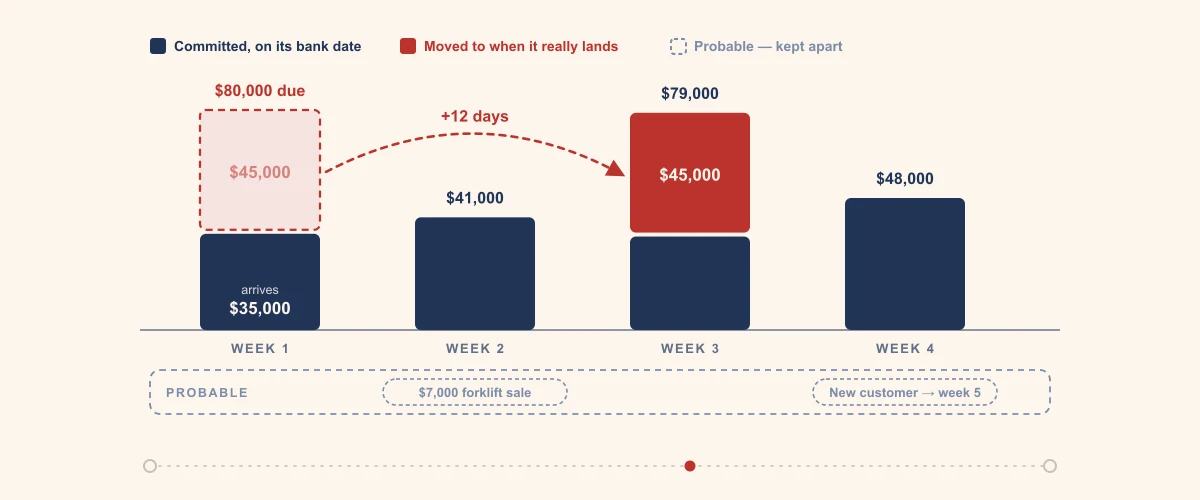
Example 1 — one large customer who pays late. Let’s take a regional packaging distributor — I’ll call it Distributor 1 — turning over about $2.6 million a year, with every customer on 30-day terms. This week, $80,000 falls due:
| Customer | Amount | Due | Usually pays | Realistic week |
|---|---|---|---|---|
| Customer A | $45,000 | Wednesday, week 1 | 12 days late | Week 3 |
| Customer B | $20,000 | Week 1 | On time | Week 1 |
| Customer C | $15,000 | Week 1 | On time | Week 1 |
| Total | $80,000 | $35,000 this week |
Customer A usually pays 12 days late, so its $45,000 comes out of this week. But where does it go? The invoice is due on Wednesday of week 1, and twelve days after that is the Monday of week 3 — not next week, the week after. So count the days from the actual due date rather than just pushing the invoice back a week.
The money isn’t lost — it has just moved. I’ll show four weeks to keep the tables readable; a full forecast runs the same logic across all thirteen. Over those four weeks, Distributor 1 collects the same total either way:
| Week 1 | Week 2 | Week 3 | Week 4 | Total | |
|---|---|---|---|---|---|
| By due date | $80,000 | $41,000 | $34,000 | $42,000 | $197,000 |
| By realistic bank date | $35,000 | $41,000 | $79,000 | $42,000 | $197,000 |
Same $197,000. But week 1 has $45,000 less in it than the aging suggests — and week 1 is the week with payroll in it. A forecast built on due dates would have counted $45,000 that won’t be there on Friday.
How to work out how late a customer really pays
Look at their payment history. Take the last six to ten paid invoices and count the days between each due date and the day the money arrived.
Example 2 — Customer A’s payment history. Here are Customer A’s last six:
| Invoice | Days late | Paid on |
|---|---|---|
| 1 | 9 | Monday |
| 2 | 14 | Monday |
| 3 | 11 | Monday |
| 4 | 15 | Monday |
| 5 | 12 | Monday |
| 6 | 11 | Monday |
| Average | 12 |
The average is 12 days, and the median is 11.5, so no single odd payment is pulling the number around.
Now look at the last column. Every payment landed on a Monday. That tells you Customer A pays in a payment run, and the spread from 9 to 15 days is mostly down to where each due date fell against that run. In my experience, one call to their accounts payable team — which Mondays do you pay, and what has to be approved first? — gets you further than any average.
- Use recent payments. A customer who paid on time two years ago may not pay on time now.
- Look at the weekday. If payments land on the same day, date each receipt to their next payment run.
- Check what’s stuck. An invoice that hasn’t been approved, or has a disputed line, won’t make the run at all.
- A promised date beats the average. If the customer has told you when they’ll pay, use that.
You only need to do this for the customers who actually move the number — usually your top ten. If you use Xero, its cash flow projection lets you add an expected payment date to an overdue invoice, so the realistic date can sit in the system rather than in a separate spreadsheet.
When to stop going customer by customer
When you have lots of small customers. Then a collection pattern from your own history is easier — and more accurate.
Example 3 — same industry, many small customers. Now take Distributor 2: same industry, about the same size, also with $80,000 due this week. But its $80,000 is spread across about 45 trade accounts, none owing more than $4,000. Going through them one by one isn’t worth the effort. Instead, look back over the last few months and ask: of everything that falls due in a week, how much usually arrives that week, the next, and the one after?
| Of the $80,000 due this week | Share | Expected |
|---|---|---|
| Arrives this week | 60% | $48,000 |
| Arrives next week | 25% | $20,000 |
| Arrives the week after | 10% | $8,000 |
| Arrives in week 4 | 3% | $2,400 |
| Later, or not at all | 2% | $1,600 |
With 45 small customers, the late ones and the early ones roughly cancel out, so the pattern holds. Try the same pattern on Distributor 1, though, and it says $48,000 arrives this week. The real answer is $35,000 — out by $13,000 — because Distributor 1’s week mostly comes down to one decision by Customer A.
So I go customer by customer where a few accounts carry the receivables, and use a pattern where there are many small ones. Most businesses need both: the top customers by name, everyone else by pattern.
Confirmed orders that aren’t invoiced yet
The steps from order to cash — delivery, invoice, payment terms — are covered in the direct forecast build. For receipts, what matters is the timing: if your customers are on 30-day terms, anything you invoice this week isn’t due until week 5. So nearly everything Distributor 1 will collect over the next four weeks is already on its AR aging. If your near-term receipts include a lot of money that hasn’t been invoiced yet, it’s worth checking whether something is being counted too early.
The exceptions are deposits due on signing, milestone billing, cash on delivery and shorter terms. If a contract says a deposit is due on signing, that’s a committed receipt with a date — put it in.
Recurring revenue: the billing date isn’t the cash date
Example 4 — subscription renewals. Take an online skincare business — I’ll call it the Online Store — that takes every payment by card through Stripe. About 600 customers are on a $45 monthly subscription, renewed on the 1st.
That’s $27,000 billed, but not $27,000 in the bank. About 5% of cards fail first time and roughly half of those are recovered on a retry, so around $26,300 arrives and about $675 a month never does. Card payments also settle a couple of business days after the charge, so it doesn’t land on the 1st either. And anyone who has cancelled drops out of next month’s line.
B2B retainers and monthly service fees are different. They’re invoiced, so they sit on your AR aging and behave just like Customer A.
Card and online sales: the sale isn’t the deposit
Example 5 — a week of card sales. Stripe’s standard settlement timing in the US is two business days, per its own payout documentation. So anything the Online Store sells from Thursday onward can’t reach the bank before the following Monday. On daily automatic payouts, the cash that lands this week is last week’s Thursday-to-Sunday sales plus this week’s Monday-to-Wednesday sales, less fees and refunds:
| Sales made | Sold | Lands this week |
|---|---|---|
| Last week, Thursday–Sunday | $16,000 | $16,000 |
| This week, Monday–Wednesday | $12,000 | $12,000 |
| This week, Thursday–Sunday | $17,000 | — (lands next week) |
| Less processing fees | −$840 | |
| Less refunds | −$1,160 | |
| Cash landing this week | $26,000 |
So the store sells $29,000 this week — $12,000 from Monday to Wednesday and $17,000 from Thursday to Sunday — but banks $26,000. The $17,000 it sells from Thursday onward won’t land until next week. That’s why I forecast card sales from the payout report, not the sales report.
Same question, two different businesses
Distributor 1 and the Online Store both need to know what will land this week. They get there very differently:
| Distributor 1 | The Online Store | |
|---|---|---|
| What you forecast from | Named customers on the AR aging | Daily sales and the payout report |
| How far ahead it’s already known | About four weeks — it’s all invoiced | A few days |
| The biggest risk to a week | One large customer paying late | Refunds, chargebacks, failed renewals |
| The number that misleads | The due date | The sales total |
That’s why there’s no single template answer to how to forecast cash flow on the receipts side. The principle stays the same — the bank date, and committed kept apart from probable. What you date it from depends on how your customers pay you.
Pipeline: keep it on its own line
Let’s say Distributor 1’s sales team is working on a new customer — a $40,000 first order, at even odds. Should it go in?
Before asking how likely it is, ask when it could possibly be cash. Even if the deal closed today and the order was invoiced this week, 30-day terms put the payment in week 5. So for the next four weeks it isn’t even upside. Further out, keep it on a probable line, dated by the full journey — close, deliver, invoice, terms — not by the close date.
Other inflows — and what isn’t a receipt at all
Rebates, refunds, insurance claims, asset sales and customer deposits all belong in the forecast, sorted into committed or probable like everything else. Distributor 1 has two this month: a $6,000 supplier rebate confirmed in writing for week 4, which is committed, and $7,000 for an old forklift a buyer is interested in, with nothing signed, which is probable.
Loans and money from the owner are different. A draw on your credit line is real cash, but it isn’t a receipt from customers — in the statement of cash flows, borrowing and equity proceeds are financing inflows, not operating ones (ASC 230-10-45-14). I keep them below the line, because a credit-line draw added into receipts makes a short week look covered.
Put together, Distributor 1’s receipts look like this:
| Week 1 | Week 2 | Week 3 | Week 4 | |
|---|---|---|---|---|
| Existing AR, on realistic dates | $35,000 | $41,000 | $79,000 | $42,000 |
| Supplier rebate (committed) | — | — | — | $6,000 |
| Committed receipts — the base case | $35,000 | $41,000 | $79,000 | $48,000 |
| Probable: forklift sale | — | $7,000 | — | — |
| Probable: new customer | — | — | — | Week 5 at the earliest |
The base case is what you plan your payments around. The probable lines sit underneath — visible, but not counted on.
How you know your receipts forecast is accurate
Example 6 — forecast against actual. Compare what you forecast with what actually arrived, every week, customer by customer. Here’s what happened at Distributor 1:
| Week 1 | Week 2 | Week 3 | Week 4 | Total | |
|---|---|---|---|---|---|
| Forecast | $35,000 | $41,000 | $79,000 | $48,000 | $203,000 |
| Actual | $35,000 | $41,000 | $34,000 | $93,000 | $203,000 |
Over the four weeks the forecast was spot on — $203,000 forecast, $203,000 received. But week 3 was out by $45,000, or 57%, because Customer A paid 19 days late this time instead of 12. Look only at the total and you’d think the forecast was perfect. Look by week and it missed exactly the week that mattered.
So when a customer moves, update their average — Customer A goes from 12 days to 13 — and find out why. Nineteen days from a customer who has never gone past fifteen usually means a missed payment run, an invoice stuck in approval, or a dispute. Do this every week and within a few months your dates come from what customers actually do rather than from assumptions. If you’re still deciding how often to run it, I’ve covered that in weekly or monthly cash flow forecast.
Start this week
You need your AR aging detail, your customers’ payment history and about an hour:
- Pull your AR aging detail, by invoice, after reconciling. If your receivables haven’t been tidied in a while, check the books first.
- For your top ten customers, work out how late they really pay from their last six invoices.
- Move each invoice into the week it will really reach the bank.
- Use a collection pattern for everyone else, then add your other sources.
- Keep probable receipts and borrowing on their own lines — and next week, compare what you forecast with what arrived.
If you’d like a second pair of eyes on your receipts schedule, email me at anant@ease.pro. I hope you have a great day.
Want the receipts side built and kept up to date for you?
Working out each customer’s real payment habits is a one-off job. Keeping them current every week is what changes decisions. If you’d like experienced finance professionals to build the forecast from your own AR and payment history, run the weekly comparison with your team and then hand it over — that’s our cash flow work.
Frequently asked questions
How do you forecast cash receipts?
List every source of incoming cash — existing invoices, confirmed orders not yet invoiced, recurring revenue, card and online sales, pipeline, and other inflows such as rebates or asset sales. Put each one in the week it will really reach your bank, using how that customer actually pays rather than the due date. Then keep committed receipts and probable receipts on separate lines, so the base case only counts money you are already owed or have contracted.
How do I work out how late a customer really pays?
Take their last six to ten paid invoices and count the days between each due date and the day the money arrived. The average is your starting point. Then look at the pattern behind it: if every payment lands on the same weekday, the customer pays in a payment run, and dating each receipt to their next run is more accurate than adding an average. If the customer has given you a specific date, use that instead.
What is the difference between committed and probable receipts?
A committed receipt is money a customer already owes or has contracted to pay — an invoice, a signed order, a subscription renewal, a rebate confirmed in writing. Its risk is timing: it may arrive late. A probable receipt is money you expect but nobody owes you yet — a pipeline deal, an asset sale under negotiation. Its risk is that it may not arrive at all. Keep them on separate lines, because they fail in different ways.
Should I weight my sales pipeline by probability in a cash forecast?
Not in the base case. A $40,000 deal at a 50% chance puts $20,000 in the forecast, but the deal will bring in either nothing or $40,000 — never $20,000 — so the week is wrong whichever way it goes. Probability weighting works for a large number of small, independent receipts, where the misses even out. For a handful of large ones, keep them on a separate probable line and plan around the base case without them.
How do I forecast receipts from online card sales?
Forecast from your payment processor's payout report, not your sales report. Card sales settle after a lag — Stripe's standard settlement in the US is two business days, so anything sold from Thursday onward cannot reach the bank before the following Monday — and what lands is net of processing fees, refunds and disputes. So this week's sales and this week's receipts are different numbers, and the gap is predictable.
How do I know whether my receipts forecast is accurate?
Compare forecast receipts with actual receipts every week, customer by customer, not just in total. A forecast can get the four-week total exactly right and still miss a single week by more than half, because one large customer moved. When a customer pays later or earlier than you assumed, update their average and ask why — a changed payment run or a disputed invoice tells you more than the number does.