Why 13 Weeks? What Makes a 13-Week Cash Flow Forecast Useful?
What cash flow is, why tracking it matters, and why 13 weeks turns out to be the right window — explained from the beginning, with one worked example.
Key takeaways
- Cash is not profit. Profit counts a sale when you make it; cash counts it when the money lands.
- A cash flow forecast is a simple list: money in, money out, week by week.
- Thirteen weeks is one quarter — long enough to see the big payments coming, short enough that you can still count them one by one.
- What catches businesses out is rarely one big payment. It is two ordinary ones landing close together.
- Update it every week and it gets more accurate, because reality keeps correcting it.
Everyone who gets handed a 13-week cash flow forecast eventually asks the same thing: why thirteen? It sounds like someone rounded a quarter and the number stuck.
Here is the short answer. Thirteen weeks is one quarter. It is far enough ahead that you can still do something about a problem, and close enough that you can count real payments instead of guessing at averages.
That answer only means something, though, if the words underneath it are clear. So let me build it up properly — what cash flow is, why it needs tracking at all, how you track it, and only then why the window is thirteen weeks. If you already know the basics, skip to why thirteen weeks.
What cash flow actually means
Cash flow is the money moving in and out of your bank account. That is all it is. It is not profit, and the gap between the two is where most businesses get caught.
Profit counts a sale the day you make it. Cash counts it the day the money arrives. Those are rarely the same day.
Say you invoice a customer $50,000 in March on 45-day terms. Your March profit goes up by $50,000. Your bank balance does not move until May. In between you still pay staff, rent and suppliers — out of money you have not received yet.
That is why a profitable business can run short. It is common enough that we wrote a whole piece on it: why your business is profitable but still running out of cash. And if you want the fuller picture of where cash disappears to — receivables, stock, supplier terms — start with our guide to cash flow management.
When an owner tells me the business is doing well, they usually mean profit. When they tell me they are worried, they almost always mean cash. Those two sentences can be true in the same month.
Why tracking cash is the habit that matters
Because your accounts tell you what already happened. Cash problems have to be seen before they arrive, and nothing in your bookkeeping looks forward.
A profit and loss statement is a report card for a period that is over. Useful, but it cannot tell you that the second week of March is going to be tight. By the time a cash problem shows up in your accounts, the week has already happened and your choices have narrowed to borrowing or apologising.
Tracking cash forward changes what you are able to do about it:
- Chase a specific invoice while there is still time for it to land.
- Move a supplier payment by a week, with a conversation rather than an apology.
- Arrange a credit line before you need it, which is also when it is cheapest.
- Delay a hire or an order by a month instead of cancelling it.
Every one of those options exists only if you saw it coming.
What a cash flow forecast is, and how you build one
A forecast is one calculation, repeated. Take the cash you have, add what is coming in, subtract what is going out, and you have next week’s balance. That balance becomes the following week’s starting point.
That is genuinely the whole model. The work is not the arithmetic — it is being honest about the two middle numbers.
Money in is not your sales figure. It is invoices you expect to actually collect, on the dates customers actually pay, which is often not the date on your terms. Money out is payroll on its real dates, rent, suppliers, loan repayments, taxes.
We have covered the build itself in detail, so I will not repeat it here:
- How to build it — the step-by-step model, including how to group receipts and payments so the forecast reflects reality.
- What data you need — the input checklist: what comes out of QuickBooks, and what only your team can tell you.
- Something to start from — the free 13-week template, already laid out.
So why thirteen weeks?
Because any forecast window forces a trade. Look further ahead and you see more, but the numbers turn into guesses. Look closer and every number is solid, but you see it too late. Thirteen weeks is where those two lines cross.
| Window | How far you see | How solid the numbers are |
|---|---|---|
| 4 weeks | This month’s bills | Near certain — but too late to change much |
| 13 weeks | A full quarter: taxes, stock builds, renewals | Real payments for the first half, good estimates after |
| 12 months | The shape of the year | Averages and assumptions, not a schedule |
Four weeks is accurate and nearly useless for planning. Twelve months is useful for planning and nearly useless for cash — it will tell you the year works without ever mentioning that one week in March does not.
A quarter is also simply how businesses schedule the things that hurt: tax payments, seasonal stock, insurance renewals, bonus runs. Thirteen weeks is the window those events live in.
What that looks like in practice
Here is the part that convinces people. Two perfectly ordinary events, both known about in advance, land four weeks apart — and only a weekly view shows what they do together.
Meet the business. A distributor with $180,000 in the bank, earning about +$8,000 of net cash in a normal week. Two things are scheduled in the quarter ahead, both entirely ordinary:
- Weeks 5, 6 and 7 — a seasonal stock build, costing $45,000 a week.
- Week 9 — the quarterly tax payment, $62,000.
Neither is a surprise. Both were decided months ago. Here is what happens to the bank balance, week by week.
| Week | What happens | Net change | Closing cash |
|---|---|---|---|
| 1 | Normal week | +$8,000 | $188,000 |
| 2 | Normal week | +$8,000 | $196,000 |
| 3 | Normal week | +$8,000 | $204,000 |
| 4 | Normal week — month 1 ends | +$8,000 | $212,000 |
| 5 | Stock build | −$37,000 | $175,000 |
| 6 | Stock build | −$37,000 | $138,000 |
| 7 | Stock build | −$37,000 | $101,000 |
| 8 | Normal week — month 2 ends | +$8,000 | $109,000 |
| 9 | Tax payment | −$54,000 | $55,000 |
| 10 | Normal week | +$8,000 | $63,000 |
| 11 | Season’s sales collect | +$28,000 | $91,000 |
| 12 | Season’s sales collect | +$28,000 | $119,000 |
| 13 | Season’s sales collect — month 3 ends | +$28,000 | $147,000 |
Each change is net of the usual +$8,000 week, so a build week is $8,000 in and $45,000 out, and week nine is $8,000 in and $62,000 out.
Now the part that matters. A monthly report only ever shows you three of those thirteen numbers — weeks 4, 8 and 13, the bolded ones, because those are the month ends:
| Month | The week it reports | Closing cash |
|---|---|---|
| Month 1 | Week 4 | $212,000 |
| Month 2 | Week 8 | $109,000 |
| Month 3 | Week 13 | $147,000 |
Every one of those is accurate. Cash dips in month two and recovers. Nothing there would make you pick up the phone.
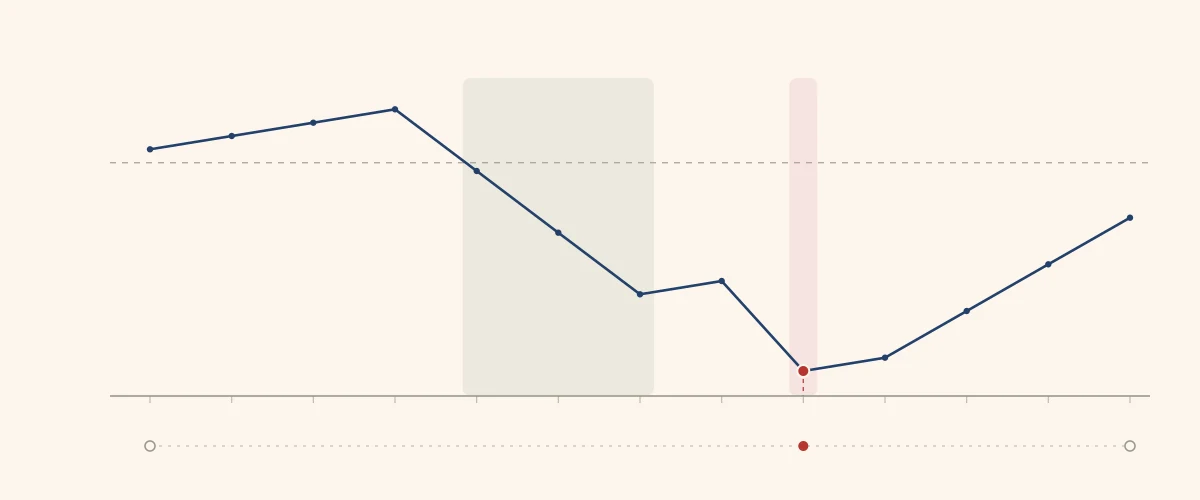
But week nine is not a month end, so it is never reported — and week nine is the bottom of the quarter at $55,000.
Closing cash by week ($000)
The three dots are month ends — the only closing balances a monthly report ever shows. The red bar is week nine, the quarter’s real low, which falls between two of them and is never reported.
If payroll is around $38,000 a fortnight, week nine leaves one payroll of headroom and no room at all for a customer paying late.
Look at what caused it. Not the stock build — the business can afford that. Not the tax payment — it was budgeted. The two of them landing four weeks apart, decided by different people at different times, with nothing that put them on the same page.
When you see it decides what it costs you:
- Seen in week one, it is a scheduling problem — move part of the build, or ask the supplier for terms.
- Seen in week eight, it is a financing problem — draw on the line, and pay for it.
- Seen in week nine, it is a phone call you did not want to make.
Want to find your own week nine? The free 13-week template lays the quarter out and marks the low week — or try the Weekly Cash Decision Calculator if this Monday is the more urgent question.
The problems a quarter catches in time
Week nine was one example. In practice the same short list of problems comes up again and again — and what they have in common is that every one of them is visible weeks before it bites, if somebody is looking that far ahead.
| What goes wrong | What it looks like | When the forecast flags it |
|---|---|---|
| Customers drifting later | Terms say 30 days; reality is 45 and slipping | Week two or three, as expected collections start missing |
| The three-payday month | Fortnightly payroll runs 26 times a year, so twice a year one month carries three | The moment you enter real payroll dates, not averages |
| Quarterly taxes | A large, fixed, entirely known payment nobody planned around | Sits in the window from day one |
| Seasonal stock | Cash goes out months before the season pays it back | As soon as the buying plan is entered |
| Annual renewals | Insurance, software, licences — one big hit, once a year | Whenever it falls inside the quarter |
| A single large customer | A third of revenue pays two weeks late | Immediately, as one line moving the whole week |
| Growth itself | More sales means more stock and more wages, all before anyone pays you | As a gap that keeps widening instead of closing |
Notice that none of these are surprises. Every one is knowable in advance — the payroll calendar is fixed, the tax dates are published, the renewal is in a contract, the customer’s real payment habits are in your own ledger. The problem was never a lack of information. It is that the information sat in six different places and nobody put it on one page with dates against it.
Growth is the one that catches people out most, because it feels like the opposite of a problem. You win a bigger order, buy more stock, take on another person — and all of that cash leaves before the customer pays. A business can grow its way into a cash crisis while every single number on the P&L improves. If that is the pattern you recognise, the forecast will show you the shape of it, but the fix is usually in the working-capital cycle: working capital inefficiency.
Almost every cash emergency I have been called into was predictable a month earlier. Not one of them involved a payment nobody knew about. They involved payments everybody knew about, that nobody had lined up side by side.
Why the later weeks are less exact
People sometimes dismiss the whole method because week twelve is “only an estimate”. It is — on purpose. Each part of the window does a different job.
Weeks 1–4 — decide
- Invoices you already hold. Payroll already dated. Loan payments already fixed.
- This is where you choose what to pay and what to chase.
- Should be close to exact.
Weeks 5–13 — watch
- Collections based on how customers really pay, not the terms you wrote.
- This is where you spot trouble, not where you plan to the dollar.
- A warning is worth acting on even if the week shifts.
A forecast claiming week thirteen to the dollar would be lying to you. It only has to be right enough to say week nine is tight.
What “rolling” means
Each week you drop the week just finished, add a fresh week at the far end, and replace your estimates with what actually happened. The window stays thirteen weeks wide, permanently.
Build a forecast once in January and by March it has quietly expired — you are looking two weeks ahead and it still looks like a full spreadsheet, which is the dangerous part.
Rolling it does something else too. Every week you compare what you predicted against what occurred, and the gaps teach you your own business: this customer always pays nine days late, that supplier bills a week after delivery, card takings land two days after the sale. Within a couple of months the forecast stops being your assumptions and starts being your actual behaviour. That is when it gets good.
When thirteen weeks is the wrong tool
It is not the answer to everything, and I would rather say so.
| If your question is | Thirteen weeks is | Use instead |
|---|---|---|
| Who do I pay this Monday? | Too wide | A weekly decision list |
| Can we afford this hire next year? | Too short | An annual plan or driver model |
| We are pre-revenue — how long do we have? | Wrong shape | A runway and burn calculation |
| Is this a timing problem or a broken model? | A symptom, not a diagnosis | Temporary or structural? |
And one honest caveat. If the same squeeze returns every quarter no matter what you do, the forecast is not your problem — something structural is, and more visibility will not fix it. That usually means cash is stuck in the working-capital cycle, which is a different piece of work: working capital inefficiency.
If you are weighing up whether this is worth the effort for your business, email me at anant@ease.pro — I am happy to tell you if I think it isn’t. I hope you have a great day.
Want the quarter mapped for your business?
We build the 13-week model on your actual numbers, run the weekly cadence with your team until the forecast has been corrected by reality a few times, and then hand it over. You keep the model and the habit.
Frequently asked questions
Why 13 weeks and not 12?
Thirteen weeks is exactly one quarter — 52 divided by four. Twelve would leave a week of every quarter unforecast, so quarterly events like tax payments would drift in and out of view depending on when you started counting.
Is a cash flow forecast the same as a budget?
No. A budget is annual and built on profit — it asks whether the business should make money this year. A cash flow forecast is weekly and built on money actually moving — it asks whether you can pay what is due. A business can be exactly on budget for the year and still be unable to cover a payment run in a particular week.
My business is small and profitable. Do I really need one?
Profit does not tell you when cash arrives. Small businesses are usually more exposed to timing, not less, because there is no buffer to absorb a late payment. If you have ever checked the balance before approving something, a forecast will pay for the hour it takes.
How long does the first one take to build?
A few hours if your books are reconciled and you have an AR aging report, your payroll dates and your loan schedule. The first version is rarely the good one — it gets accurate by being run weekly and corrected against what actually happened.
What if my books are behind?
Fix that first. A forecast built on unreconciled data gives you a precise, confident, wrong answer — which is worse than no forecast, because you will act on it. Catch the bookkeeping up, then build.
Do lenders and investors actually ask for 13 weeks?
It is the format banks, lenders and turnaround professionals work in. Running one means that when someone asks for visibility on cash, you hand over a document already in the shape they read, instead of building one under pressure.