Does My Business Need a Weekly Cash Flow Forecast?
Does your business need a weekly cash flow forecast? A ten-minute bank-statement test, six warning signs, and a worked example of when monthly isn't enough.
Key takeaways
- You need a weekly cash flow forecast if your cash can fall below your minimum inside a month, even when every month ends fine.
- Test it in ten minutes: find the lowest balance in each of your last three bank statements and compare it with the month-end balance.
- Six things make the dip inside a month bigger: payroll frequency, uneven customer payments, large supplier payments, debt and tax dates, seasonal swings, and thin headroom.
- If your low point sits close to your month-end balance, a monthly forecast is enough. Weekly costs time; only pay it if you need it.
The question I usually get: “My monthly budget looks fine. Do I really need to forecast week by week?”
You need a weekly forecast if your cash can drop below the minimum you need to hold somewhere inside a month — even when every month starts and ends comfortably. A monthly forecast only shows month-ends. Payroll, rent and supplier payments don’t wait for the end of the month.
That matters because the week your cash is lowest is the week you can’t pay someone. If you only find out on the day, your options are an overdraft or a difficult phone call. Seen a few weeks ahead, it’s a small change to when you pay or collect.
This piece is a test for whether your business needs the weekly view. It doesn’t cover which forecast answers which decision — that’s in weekly or monthly — or how to build one, which is in the 13-week model.
The test is one comparison:
The ten-minute test: your last three bank statements
Most bank statements show a running balance after each transaction. For each of the last three months, write down three numbers: the opening balance, the lowest balance, and the closing balance.
| For each month | Where to find it |
|---|---|
| Opening balance | First line of the statement |
| Lowest balance | The smallest running balance in the month |
| Closing balance | Last line of the statement |
Then compare the lowest balance with two things: the month-end balance, and the minimum cash you never want to go below.
- Low point close to the month-end balance, and well above your minimum: your monthly view isn’t hiding much. A monthly forecast is enough.
- Low point far below the month-end balance: your monthly view is missing a week. Check how close that low point came to your minimum.
- Low point near or below your minimum: you need a weekly forecast, whatever the month-end looks like.
If you haven’t set a minimum yet, set one now, with a reason — say, a payroll plus a week of supplier payments. How to choose it is in the headroom test.
Example 1: a distributor whose budget looks healthy
A business with weekly payroll, customers who take 45 days to pay, and one large supplier payment a month. Every month ends fine. One week of every month doesn’t.
Let’s take an industrial supplies distributor — I’ll call it the Distributor — turning over about $6.6 million a year. It pays its staff $15,000 every Friday. Its main supplier is paid $285,000 on the 10th of each month, for the previous month’s stock. Its customers pay about 45 days after delivery, and its largest customer pays $130,000 once a month, on its own payment run at the end of the month. It never wants to drop below $75,000.
Here is a four-Friday month as its monthly budget sees it:
| The month | Amount |
|---|---|
| Opening cash | $250,000 |
| Customer receipts | +$520,000 |
| Main supplier, other suppliers, payroll, overhead and loan | −$507,000 |
| Closing cash | $263,000 |
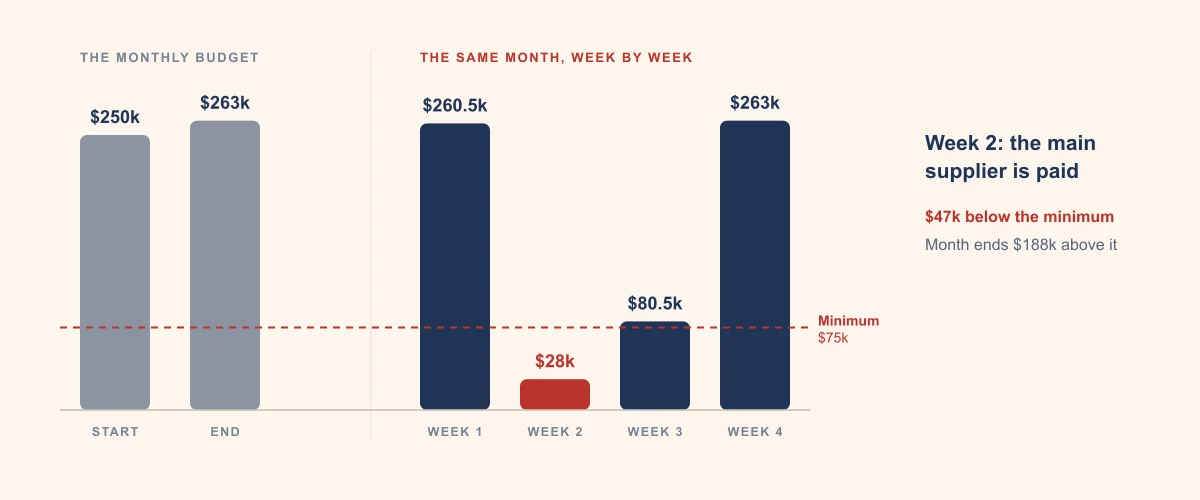
The month adds $13,000 and closes $188,000 above the minimum. Nothing to worry about.
Here is the same month, week by week:
| Week 1 | Week 2 | Week 3 | Week 4 | |
|---|---|---|---|---|
| Opening cash | $250,000 | $260,500 | $28,000 | $80,500 |
| Customer receipts | $97,500 | $97,500 | $97,500 | $227,500 |
| Payments | −$87,000 | −$330,000 | −$45,000 | −$45,000 |
| Closing cash | $260,500 | $28,000 | $80,500 | $263,000 |
Week 2 is the 10th: the $285,000 supplier payment goes out alongside payroll and the other suppliers. Cash falls to $28,000 — $47,000 below the minimum — in a month that ends with $263,000.
Run the test. The dip is $250,000 − $28,000 = $222,000. Cash above the minimum at the start was $250,000 − $75,000 = $175,000. The dip is bigger, so the Distributor needs a weekly forecast.
Why it happens. The Distributor pays for a whole month of stock in one payment on the 10th, but its customers pay a little at a time, about 45 days after delivery. So in week 2 a month’s worth of stock goes out in one day, while only a week’s worth of customer receipts comes in. The month-end balance hides that, because by then three more weeks of receipts — and the largest customer’s payment — have arrived.
None of this is a surprise, and none of it is a problem — once it’s on a weekly forecast. Seen in advance, the Distributor can draw on a credit line for a few days, ask the supplier to split the payment, or ask the largest customer to pay earlier. Seen on the 10th, it’s an overdraft.
Example 2: when monthly is enough
Not every business needs the weekly view. If the money comes in before the big payments go out, the month-end balance already shows the low point.
Take a bookkeeping practice whose clients pay a monthly retainer by ACH on the 1st, with payroll twice a month and rent on the 1st. Its cash is highest just after the retainers arrive and lowest just before the next month’s arrive — which is almost exactly the month-end balance its monthly budget already shows. The dip inside the month is small, so the monthly view isn’t hiding anything. Cash flow forecast frequency should follow the shape of your month, not the size of your business.
Six things that make the dip bigger
If the ten-minute test is close, these tell you which way you’re heading. Each one makes the gap between your month-end balance and your low point wider.
| What to look at | Points to weekly | Monthly is usually enough |
|---|---|---|
| Payroll | Weekly or every two weeks | Once or twice a month, on fixed dates |
| Customer payments | Uneven, late, or one customer is a large share of receipts | Small, frequent receipts, or paid in advance |
| Supplier and stock payments | Large payments on fixed dates, or stock paid for long before it sells | Spread evenly across the month |
| Debt and tax dates | Large loan payments, payroll tax deposits or quarterly taxes in one week | Small, or spread out |
| Seasonality | Stock builds or slow months before the busy season | A steady year |
| Headroom | Cash above your minimum is less than your largest payment week | Comfortably more than your largest payment week |
A few things worth knowing about these:
- Weekly payroll doesn’t fit a month. It runs 52 times a year, so most months have four paydays and some have five — four months in 2026, five in 2027. A five-Friday month carries about 15% more payroll than an average month. Pay every two weeks and twice a year one month has three paydays.
- Payroll tax deposits follow their own IRS schedule, monthly or semiweekly, set by your past tax liability.
- Headroom is the deciding one. The Distributor’s largest payment week was $330,000 against $175,000 of headroom. When one week’s payments are bigger than your cushion, you’re relying on that week’s receipts arriving on time to stay above your minimum.
Why averaging these into a monthly figure goes wrong is covered in the most common forecasting mistake.
Score your business
Answer these six questions. The last one decides; the other five tell you how likely the dip is.
- Do you pay staff weekly or every two weeks?
- Do one or two customers make up a large share of your receipts, or pay unevenly?
- Do you make large supplier or stock payments on fixed dates?
- Do large loan, rent or tax payments land in the same week?
- Does your business have a busy season you pay for in advance?
- Did your lowest balance in any of the last three months come near your minimum — or is your cash above the minimum less than your largest payment week?
- Yes to the last question: build a weekly forecast now.
- No to the last question, yes to any of the others: run the ten-minute test every month. The first month the low point gets near your minimum, move to weekly.
- No to all six: a monthly forecast is enough for now.
What the weekly view costs you
A few hours to build the first one, then 30 to 60 minutes a week to keep it current.
For most small businesses, the weekly view means a 13-week cash flow forecast: a short-term cash flow forecast covering one quarter, week by week, with receipts and payments on their real dates. It doesn’t replace your monthly budget. The first 13 weeks go week by week, and everything after that stays monthly — one model, read two ways. Why the window is thirteen weeks is in why 13 weeks, and the build itself, line by line, is in the weekly build.
When an owner tells me their budget says they’re fine, I ask for their bank statements, not the budget. The lowest balance in the month tells me more than any month-end figure. If it keeps getting close to the minimum, the business needs a weekly forecast — usually before anyone has noticed.
Start this week
Take your last three bank statements and write down three numbers for each month.
- Opening, lowest and closing balance for each of the last three months.
- Your minimum cash, with the reason behind it.
- Your largest payment week — the week your biggest supplier, payroll and loan payments land together.
If the test says weekly, our free 13-week cash flow template lays the quarter out and flags your lowest week. If this Friday is the more urgent question, start with the Weekly Cash Decision Calculator.
If you’d like a second opinion on what your statements show, email me at anant@ease.pro. I hope you have a great day.
Not sure whether you need the weekly view?
We look at your bank statements and payment calendar, tell you honestly whether a weekly forecast is worth it for your business, and if it is, build it on your ledger and run it with your team until it holds.
Frequently asked questions
Does a small business need a weekly cash flow forecast?
Not every one. A business needs a weekly forecast when its cash can fall below the minimum it needs to hold during a month, even though every month ends comfortably. That usually happens when large payments land on fixed dates while customer receipts arrive later or unevenly. If your lowest balance each month is close to your month-end balance, a monthly forecast is usually enough.
How do I know if a monthly cash flow forecast is enough?
Look at your last three bank statements. For each month, find the lowest balance and compare it with the month-end balance and with the minimum cash you need to hold. If the low point is regularly far below the month-end balance, or gets near your minimum, your monthly view is hiding the week that matters and you need a weekly forecast.
What is a short-term cash flow forecast?
A forecast of cash in and out over the next few weeks or months, usually by week. The most common form is the 13-week cash flow forecast: one quarter, week by week, with receipts and payments on their real dates. It is built to answer whether you can cover what is due, not whether the year will be profitable.
Is a 13-week cash flow forecast worth it for a small business?
If your cash dips below your minimum inside a month, yes, because it shows the tight week while there is still time to move a payment or chase a receipt. Once built, keeping it current takes 30 to 60 minutes a week. If your cash never dips far below its month-end level, a monthly forecast does the job with less effort.
How often should a cash flow forecast be updated?
A weekly forecast should be updated every week: drop the week that has finished, add a new one at the end, and replace the opening balance with the actual bank balance. A monthly planning forecast is updated monthly, or whenever a real assumption changes.
How much cash should a business keep as a minimum?
It depends on the business. A common way to set it is to cover the payments you can't move — payroll, rent, loan payments — for a short period, plus a cushion for a large customer paying late. Write the number down with the reason behind it, and use it as the line your forecast must stay above.