What Are the Most Common Cash Flow Forecasting Mistakes?
The most common cash flow forecasting mistake is averaging payments that each have their own rhythm. All eight mistakes, and the check that catches each one.
Key takeaways
- The mistake we see most often is averaging: spreading last year’s payments evenly across every week or month. Payroll, rent, loans and annual renewals each have their own rhythm, and they land together. An average gets the year right and the weeks wrong.
- Close behind: dating customer receipts by the invoice due date instead of when the money really arrives.
- Most cash flow forecasting mistakes aren’t about the totals. They put cash in the wrong week, at the wrong amount, or leave a payment out altogether.
- A forecast built on books that aren’t reconciled is wrong before you start — often by the same amount every week.
- Taxes, debt, capex and annual one-offs are the payments most often missing. They’re all on a calendar somewhere.
- The habit that catches every other mistake: compare last week’s forecast with the bank, line by line, every week.
The question I usually get, a few weeks after someone has built their first forecast: “The forecast said we’d be fine this week. We weren’t. What did we get wrong?”
Most often, the forecast was built on averages: last year’s payments and receipts spread evenly across every week or month. But payments have their own frequency. Payroll goes out every week or two, rent and loans monthly, insurance once a year — and several often hit the bank in the same week. The average gets the year right and the weeks wrong.
That’s one of eight mistakes we see again and again, and most of them do the same thing: put the right money in the wrong week. That’s why they’re easy to miss. The month looks right. The week with payroll in it doesn’t.
It matters because the whole point of a forecast is to show you a tight week while there’s still time to do something about it. A forecast with one of these mistakes in it tells you the week is fine — right up until Friday.
This piece goes through the eight, what each one looks like when it happens, and the check that catches it. Taken together, the eight checks make a short list of cash flow forecasting best practices. I won’t rebuild the method here; each mistake links to where we’ve covered the fix in full. If you haven’t built a forecast yet, start with the full weekly build.
Every mistake below shows up as one of three cash flow forecasting errors — the same three we use to measure cash flow forecast accuracy:
Mistake 1: Averaging payments and receipts instead of dating them
Payments don’t leave your bank on average. Each one has its own rhythm — weekly, every two weeks, monthly, once a year — and several often land in the same week. Forecast each on its real date.
This is the mistake we see most often. The owner takes last year’s payments, divides by 52 or by 12, and puts the same number in every week or every month. The total for the year is right. Almost every week is wrong.
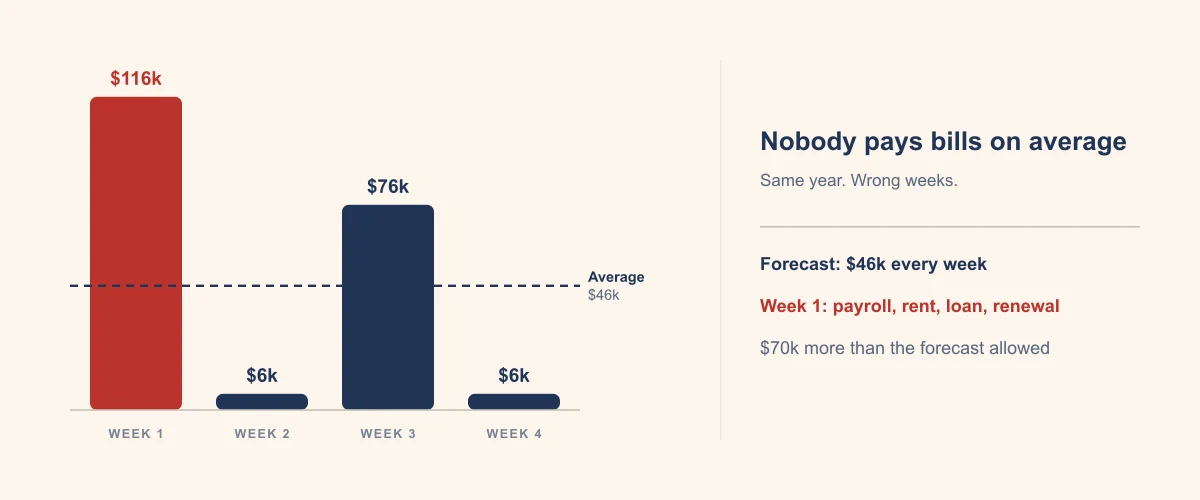
Example 1 — the week everything lands. Let’s take a marketing agency — I’ll call it the Agency — billing about $3.1 million a year. Last year it paid out $2,392,000, so its forecast shows $46,000 going out every week. Here’s what actually goes out, and how often:
| Payment | How often | Amount |
|---|---|---|
| Payroll | Every two weeks | $70,000 |
| Freelancers and suppliers | Weekly | $6,000 |
| Office rent | Monthly, on the 1st | $15,000 |
| Loan repayment | Monthly | $5,000 |
| Insurance renewal | Once a year | $20,000 |
Over a year those add up to the same $2,392,000. Now take the month the insurance renews, with a payday in the first week:
| Week 1 | Week 2 | Week 3 | Week 4 | |
|---|---|---|---|---|
| Forecast on the average | $46,000 | $46,000 | $46,000 | $46,000 |
| What actually goes out | $116,000 | $6,000 | $76,000 | $6,000 |
Week 1 needs $70,000 more than the forecast allowed for. Weeks 2 and 4 look busier than they are. The average got the year right and every week wrong.
Receipts behave the same way. If most clients pay in the first week of the month, an average spreads that money into weeks where none arrives. And an average hides the trend: if payroll went up with two hires in March, or a large customer has been paying a little later each quarter, last year’s average still shows the old picture.
The calendar has its own traps. Payroll every two weeks means 26 pay runs a year, so twice a year one month has three paydays instead of two — an averaged forecast never shows it. Federal payroll taxes are deposited on their own monthly or semiweekly schedule, set by the IRS from your past tax liability, not whenever it suits the forecast.
An average is fine for the many small, frequent costs — office supplies, fuel, bank fees. It’s the large payments with their own calendar that it breaks.
The check: list every large payment with how often it’s paid and its next date, and put each one on that date. Do the same for your largest customers’ receipts. Keep averages for the small, frequent items only. The calendar items are listed in the data checklist.
Mistake 2: Dating customer receipts by the invoice due date
The due date is when a customer agreed to pay. It isn’t when they pay. Forecast the week the money will actually reach your bank.
Example 2 — a payroll Friday. Let’s take a commercial cleaning contractor — I’ll call it the Cleaning Company — turning over about $2.4 million a year. Most of its clients are billed at month-end, so a lot of invoices fall due in the same week. This week, $80,000 is due. It starts the week with $30,000 in the bank, pays $15,000 to suppliers on Tuesday and $55,000 in payroll on Friday, and never wants to drop below $20,000.
On due dates, the week looks comfortable. But $45,000 of that $80,000 comes from two clients who, on their history, pay about two weeks late:
| This week | Forecast on due dates | What happened |
|---|---|---|
| Opening cash | $30,000 | $30,000 |
| Customer receipts | $80,000 | $35,000 |
| Suppliers (Tuesday) | −$15,000 | −$15,000 |
| Cash before payroll (Friday) | $95,000 | $50,000 |
| Payroll | −$55,000 | −$55,000 |
| Closing cash | $40,000 | −$5,000 |
The forecast showed $20,000 to spare above the minimum. In reality the business had $50,000 on Friday morning against a $55,000 payroll — $5,000 short. The $45,000 arrived two weeks later, so the forecast was right about the money and wrong about the week. That’s still the miss that mattered.
The check: for your top ten customers, look at how they actually paid their last six invoices and date each open invoice from that. We’ve covered how in how to forecast cash receipts accurately, and which evidence should win in due dates vs payment behavior.
Mistake 3: Building on books that aren’t reconciled
If the bank balance in your forecast doesn’t match the bank, or your AR aging includes invoices already paid, every week starts from the wrong number.
It’s the easiest mistake to spot once you look for it: the forecast is wrong by roughly the same amount every week. Common causes are customer payments not matched to their invoices, payments recorded twice, and bank accounts that haven’t been reconciled for a month or two.
The check: start from the actual bank balance today, and reconcile receivables before you date them. If the books are behind, fix them first.
Mistake 4: Leaving out taxes, debt and capex
These are the payments people forget because they don’t run through accounts payable. They’re still cash out.
Loan repayments come straight out of the bank. Quarterly estimated taxes, sales tax and payroll tax deposits run on their own calendars. Capex — a vehicle, equipment, a fit-out — is often decided after the forecast is built. Most of it never shows up in an AP aging.
The check: list every loan and lease, every tax you pay and its dates, and anything management has approved but not yet ordered. Then compare your forecast’s payment lines with the last two months of bank statements. Anything regular in the bank that isn’t in the forecast is a missing line. The full list of categories your payments fall into is in the weekly build.
Mistake 5: Counting sales that haven’t been won
A deal in the pipeline isn’t cash, and neither is a sale you’ve made but haven’t invoiced. Each step between them takes time.
A new deal has to close, be delivered and invoiced, and then wait out the payment terms. On 30-day terms, a deal that closes today is more than a month from the bank — usually longer. And putting it in “at 50%” doesn’t help: a $40,000 deal brings in nothing or $40,000, never $20,000.
The check: your base case only counts money someone already owes you or has contracted to pay. Everything else goes on its own line — the split between committed and probable receipts.
Mistake 6: Missing the one-off payments
Recurring costs behave. One-offs are what actually empty a bank account — and they’re absent from any average built on last year’s months.
The annual insurance renewal, software that renews on its anniversary, bonuses, a deposit to a new supplier, an owner distribution. Each one is manageable on its own. Three landing in the same fortnight is how a profitable business ends up unable to make a payment run.
The check: go through last year’s bank statements for anything large that happened once, and ask whether it happens again in the next thirteen weeks. The usual suspects are in the one-offs that break a forecast.
Mistake 7: Too much detail — or too little
Forecasting every small transaction makes the model too slow to update. Forecasting everything as one line hides the payments that matter.
The fix is to match the detail to the decision. Named customers, payroll, rent, tax and large suppliers go on their real dates. The many small costs go in as a weekly allowance from recent spending. And the further out you look, the more you move from individual invoices towards drivers — I’ve set out how much detail each horizon needs.
The check: if updating the forecast takes more than an hour a week, you’ve gone too detailed. If you can’t say which customer a week’s receipts depend on, you’ve gone too broad.
Mistake 8: Never rolling it forward — or never checking it
A forecast built once and left alone gets shorter and staler every week. A forecast that’s never compared with the bank never gets better.
These two go together. Each week, drop the week that’s finished, add a new week at the end, and replace the opening balance with the actual bank balance — that’s what makes a forecast rolling. Then put last week’s forecast next to what actually happened, line by line, and decide which of the three errors each difference was.
This is the habit that catches mistakes 1 to 7. A week that’s far off while the month is roughly right points to mistake 1. A receipt that keeps arriving late points to 2. A payment you didn’t expect points to 4 or 6. A gap that’s the same every week points to 3. The full routine is the weekly actual-vs-forecast review.
The mistake I see most often is the first one on this list. A forecast built on averages looks tidy and gets the year right, but nobody pays bills on average. Payroll, rent, the loan and an annual renewal land in the same week, and that’s the week the average hides. I’d rather see a forecast with fewer lines on their real dates than many lines on averages.
A ten-minute check before you trust a forecast
Run through these before you make a payment decision on a forecast. Each one maps to a mistake above.
- Is every payroll, rent, tax, loan and annual payment on its real date, at its real frequency — not averaged across weeks or months? (Mistake 1)
- Do your largest receipts have a date from how the customer actually pays, not just the due date? (2)
- Does the opening balance match the bank today, and has the AR aging been reconciled? (3)
- Are loan repayments, tax payments and approved capex in the forecast, even though they’re not in AP? (4)
- Is everything in the base case already owed or contracted, with pipeline on its own line? (5)
- Have you checked last year’s bank statements for one-offs due again in the next thirteen weeks? (6)
- Can you update the whole forecast in under an hour? (7)
- Did you compare last week’s forecast with the bank, and roll it forward a week? (8)
If you’re starting from scratch, our free 13-week cash flow template is laid out to avoid most of these by design, and the AR collection forecast template handles the second one invoice by invoice.
If you’d like a second pair of eyes on your forecast, email me at anant@ease.pro. I hope you have a great day.
Want your forecast checked against these mistakes?
Most forecasts we review have two or three of these in them, and the owner usually knows something feels off without knowing which. If you’d like experienced finance professionals to review your forecast, fix what’s missing and run the weekly check with your team until it holds, that’s our cash flow work.
Frequently asked questions
What are the most common cash flow forecasting mistakes?
Eight come up again and again: averaging payments and receipts instead of putting each on its real date, dating customer receipts by the invoice due date instead of when the money arrives, building on books that aren't reconciled, leaving out taxes, debt and capex, counting sales that haven't been won, missing one-off payments, forecasting in too much detail, and not rolling the forecast forward or comparing it with what actually happened in the bank.
Why do cash flow forecasts fail?
Usually not because the totals are wrong, but because cash lands in a different week from the one forecast, or a payment that was never in the forecast arrives. A forecast can get the month right and still miss the one week with payroll in it. Every failure is one of three things: the wrong week, the wrong amount, or a line that was missing.
What is the biggest cash flow forecasting error?
The one we see most often is averaging: taking last year's payments or receipts and spreading them evenly across every week or month. Payments don't arrive on average. Payroll runs every week or two, rent monthly, insurance once a year, and they often land in the same week. An averaged forecast gets the year right and the weeks wrong, which is exactly where a forecast is meant to help.
How do I check whether my cash flow forecast has a mistake in it?
Compare last week's forecast with what actually came in and went out of the bank, line by line. A week that's far off while the month is roughly right points to averaging; a miss on receipts usually points to the due-date mistake; a payment you didn't expect points to a missing line; a gap that is the same every week points to an opening balance that isn't reconciled. Then fix the assumption, not just the number.
Should a cash flow forecast include every small expense?
No. Put large and fixed payments, such as payroll, rent, tax, debt and big suppliers, on their real dates, and use a weekly allowance from recent spending only for the many small, frequent ones. Forecasting every small transaction separately takes time without improving the decision, and it makes the forecast too slow to update each week.
How often should a cash flow forecast be updated?
For a short-term forecast, every week. Drop the week that has finished, add a new week at the end, replace the opening balance with the actual bank balance, and compare what you forecast with what happened. A forecast that isn't rolled forward gets shorter and staler each week until it no longer shows the problems coming.